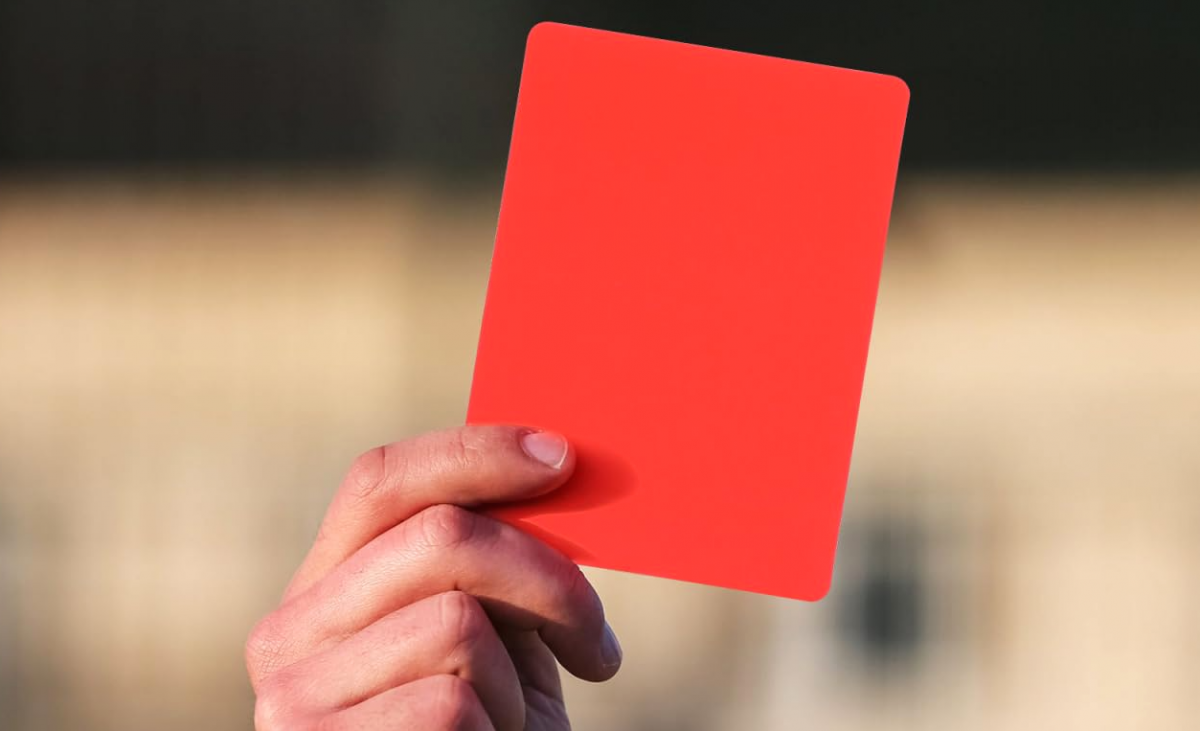
A red card is one of the most serious disciplinary sanctions in soccer. When a referee sends off a player during a match, that player must leave the field and cannot return. The team continues with one fewer player, often forcing an immediate change in formation, defensive responsibilities, and attacking strategy.
Red cards are issued for offenses such as serious foul play, violent conduct, and denying an obvious goal-scoring opportunity. A player can also be dismissed after receiving two yellow cards in the same match. While the immediate consequences are established by the Laws of the Game, any subsequent suspension is governed by the relevant competition’s disciplinary regulations.
Understanding soccer red card rules involves more than recognizing the referee’s signal. The nature of the offense, its location, and whether the dismissal follows a straight red card or a second caution can all affect how the rules are applied.
What Is a Red Card in Soccer?
In soccer, a red card signals that a player, substitute, substituted player, or team official has been sent off. The referee displays the card to communicate the decision to the players, coaching staff, and spectators.
Yellow and red cards made their FIFA World Cup debut in 1970, providing a visual system that could be understood regardless of language. Yellow indicates a caution, while red means dismissal. Both remain fundamental to disciplinary decisions in modern soccer.
For a player participating in the match, a red card has several immediate consequences:
- The player must leave the field and its immediate surroundings, including the technical area.
- The dismissed player cannot return or be replaced by a substitute.
- The team continues with one fewer player for the remainder of the match.
- The incident is recorded in the referee’s report and may lead to a suspension.
Not every red card leaves a team short-handed on the field. Dismissing a substitute or a player who has already been substituted does not reduce the number of players participating in the match.
The timing of a dismissal also matters. If a named starting player is sent off after the team sheets have been submitted but before kickoff, a named substitute may take their place. The team does not receive an additional substitution allowance.
Under Law 3, a match cannot start or continue if either team has fewer than seven players. Multiple dismissals can therefore prevent a match from being completed.
What Are the Reasons for a Red Card?
Law 12 of the IFAB Laws of the Game identifies the offenses that warrant dismissal. Some involve dangerous physical challenges, while others concern misconduct, deliberate interference with scoring opportunities, or a second caution.
A player, substitute, or substituted player can be sent off for:
- Serious foul play.
- Violent conduct.
- Spitting at or biting another person.
- Using offensive, insulting, or abusive language or actions.
- Denying a goal or an obvious goal-scoring opportunity through a handball offense, subject to the applicable exceptions.
- Denying an obvious goal-scoring opportunity through an offense punishable by a free kick, unless a specific exception applies.
- Receiving a second yellow card in the same match.
- Entering the video operation room (VOR), where VAR is in use.
Physical contact is not required for every sending-off offense. Abusive language, deliberate handball, and certain other forms of misconduct can also result in dismissal.
Serious Foul Play and Violent Conduct
Serious foul play and violent conduct can both involve excessive force, but they describe different types of misconduct.
Serious foul play involves a tackle or challenge that endangers an opponent’s safety or uses excessive force or brutality while competing for the ball. A high-speed tackle with exposed studs, for instance, may warrant a red card if the point of contact and force create a significant risk of injury.
An injury does not have to occur. Referees consider the player’s speed, control, intensity, and the danger created by the challenge.
Violent conduct generally occurs when a player uses or attempts to use excessive force or brutality against another person without challenging for the ball. Punching, headbutting, or striking an opponent during an argument can fall into this category.
The offense is not restricted to opposing players. Violent conduct may involve teammates, substitutes, match officials, spectators, or other individuals.
The difference lies primarily in the circumstances of the action. A dangerous tackle during a genuine contest for the ball may constitute serious foul play. Striking an opponent after play has stopped is normally treated as violent conduct.
Referees also distinguish between careless, reckless, and excessively forceful challenges. A careless foul does not require a disciplinary card. A reckless challenge warrants a yellow card, while excessive force or an action endangering an opponent’s safety requires dismissal.
Denying an Obvious Goal-Scoring Opportunity
Denying an obvious goal-scoring opportunity, commonly known as DOGSO, is another major reason for a straight red card.
A DOGSO offense occurs when a player illegally prevents an opponent from having an obvious opportunity to score. Contrary to a common misconception, being the last defender does not automatically make a foul a red card offense.
Referees assess four main factors:
- Distance to goal: How close the attacker was to the opposing goal.
- Direction of play: Whether the attack was moving toward goal.
- Likelihood of control: Whether the attacker possessed the ball or was likely to gain control.
- Location and number of defenders and attackers: Whether defenders could realistically intervene, taking into account the positions and numbers of players from both teams.
A defender who pulls down an attacker running clear toward goal may receive a straight red card if these circumstances establish an obvious scoring opportunity.
However, the penalty area introduces an important exception. When a defender commits a DOGSO offense inside their own penalty area and the referee awards a penalty, an offense involving an attempt to play the ball or a challenge for the ball is normally punished with a yellow card.
This reduction does not apply to holding, pulling, pushing, or offenses where there was no possibility of playing the ball. Such actions can still result in dismissal despite the penalty award.
Handball offenses have their own disciplinary distinctions. Deliberate handball that denies a goal or an obvious goal-scoring opportunity normally results in a red card, even when a penalty is awarded. If an unintentional handball offense denies a goal or an obvious scoring opportunity and a penalty is awarded, the player is cautioned instead.
Straight Red Card vs Two Yellow Cards
A player can be dismissed through a straight red card or by receiving two yellow cards in the same match.
A straight red card follows a single sending-off offense, such as serious foul play, violent conduct, or certain DOGSO incidents. No previous caution is necessary.
A second-yellow-card dismissal occurs when a player who has already been cautioned commits another cautionable offense. The referee shows the second yellow card followed by a red card.
| Straight red card | Two yellow cards |
| Results from one sending-off offense | Results from two separate cautions |
| Requires no previous caution | Requires an earlier yellow card |
| May involve violent conduct, serious foul play, or DOGSO | May involve reckless challenges, dissent, delaying a restart, or other cautionable conduct |
| May carry a longer suspension, depending on the offense | Often carries a shorter standard suspension under competition rules |
Both dismissals have the same immediate effect when they involve a player on the field. The difference matters when suspensions are assessed after the match.
Yellow cards from previous matches do not count toward a two-yellow-card dismissal in the current match. Competitions may, however, impose separate suspensions for accumulated cautions.
What Happens When a Player Gets a Red Card?
Once a player has been sent off, the referee ensures that the player leaves the required area before play resumes. The restart depends on the offense and when it occurred.
A direct-free-kick offense may result in a direct free kick or penalty, depending on its location. Other forms of misconduct can lead to an indirect free kick. If the ball was already out of play, the original restart generally remains unchanged.
An early dismissal can force a team to rethink its entire approach.
A team reduced from eleven to ten players may abandon its original formation to protect defensive space. Coaches sometimes withdraw an attacker, move a midfielder into defense, or adopt a more compact shape to reduce the opponent’s opportunities.
The position of the dismissed player influences the adjustment. Losing a central defender can disrupt the defensive line, while losing a central midfielder may weaken possession and make it harder to control transitions.
Playing a man down also increases the physical demands on the remaining players. Defending wider areas, tracking additional runners, and maintaining pressure on the ball become more difficult as fatigue develops.
The score and time remaining often dictate how a team responds. A team protecting a narrow lead late in the game may prioritize defending its penalty area. A team trailing by two goals might continue attacking despite the increased risk of conceding.
A red card does not automatically decide the result. Teams with ten players can still score, defend successfully, or win through effective tactical adjustments.
If the match proceeds to extra time, the dismissal remains in effect. The team cannot restore its original number of players simply because regulation time has ended.
How Long Is a Player Suspended After a Red Card?
There is no universal suspension length for every red card in soccer. The IFAB Laws of the Game establish which offenses require dismissal, but competition organizers and disciplinary authorities determine the sanctions that follow.
A dismissal for two yellow cards commonly results in a one-match suspension. Some straight red card offenses also carry a standard one-match ban, while serious foul play, violent conduct, and other serious misconduct can lead to longer suspensions.
Disciplinary authorities may consider:
- The offense recorded in the referee’s report.
- Whether the dismissal followed a straight red card or a second caution.
- The competition’s disciplinary regulations.
- Previous offenses or aggravating circumstances.
- Additional sanctions imposed following a disciplinary hearing.
For example, a competition may impose different standard suspensions for DOGSO, serious foul play, and violent conduct. Although the sending-off decision follows the Laws of the Game, the resulting suspension can differ between tournaments.
Suspensions also do not necessarily apply across every competition. Domestic leagues, national cups, and international tournaments may have separate disciplinary systems and rules governing when bans must be served.
Appeals are possible under some competition regulations. A club may challenge a dismissal when the rules permit, particularly if it believes a straight red card was issued incorrectly. The available evidence, appeal deadlines, and grounds for overturning a decision depend on the governing authority.
Can Goalkeepers Receive Red Cards?
Goalkeepers are subject to the same general disciplinary rules as outfield players. They can be dismissed for serious foul play, violent conduct, DOGSO, or receiving a second yellow card.
The main difference concerns handling the ball. Goalkeepers are permitted to use their hands and arms inside their own penalty area, subject to the restrictions established by the Laws of the Game. Outside that area, the normal handball rules apply.
A goalkeeper who deliberately handles the ball outside the penalty area to prevent an obvious goal-scoring opportunity can therefore receive a straight red card.
Goalkeepers can also commit DOGSO offenses through challenges on attacking players. If a goalkeeper fouls an attacker inside the penalty area while genuinely attempting to play or challenge for the ball, a yellow card rather than a red card may be appropriate when a penalty is awarded.
By contrast, pulling down an attacker without attempting to play the ball does not qualify for that reduction.
A goalkeeper’s dismissal also creates an immediate positional problem. Every team must have a goalkeeper on the field.
If the team is still permitted to make a substitution, a reserve goalkeeper can enter in place of an outfield player. Otherwise, an existing outfield player must take over in goal.
In either case, the team continues with the numerical disadvantage caused by the dismissal.
Can VAR Overturn a Red Card?
The Video Assistant Referee (VAR) system can assist with certain major refereeing decisions, including direct red cards and clearly incorrect second cautions that result in dismissal. Its purpose is to correct clear and obvious errors or serious missed incidents, not to reconsider every disputed foul.
Under the 2026/27 VAR protocol, reviewable red card incidents include serious foul play, violent conduct, DOGSO, and dismissals caused by a clearly incorrect second yellow card. VAR may also identify an eligible incident that the referee did not initially see.
A review generally follows this process:
- The VAR team examines footage of a potentially reviewable incident.
- If a clear and obvious error or serious missed incident is identified, VAR communicates with the referee.
- The referee may review footage at the pitchside monitor, particularly when the decision requires subjective judgment.
- The referee makes the final decision, confirming, changing, or cancelling the original sanction.
VAR cannot independently overturn a red card. Final authority remains with the on-field referee.
A direct red card can be cancelled if the review establishes that the incident did not warrant dismissal. Conversely, a yellow card may be upgraded to a straight red if the footage reveals a sending-off offense.
Under the 2026/27 VAR protocol, a clearly incorrect second yellow card that results in a dismissal can also be reviewed. However, VAR cannot intervene to recommend a second caution that the referee failed to issue. The additional review power is limited to correcting an obvious error that has already resulted in a player being sent off.
VAR’s scope remains limited to defined reviewable categories, including goals, penalty decisions, red cards, and mistaken identity. Competitions may also authorize reviews of clearly incorrect corner-kick awards when the decision can be corrected immediately without delaying the restart.
FAQ
Can a Team Replace a Player Who Receives a Red Card?
No. A player sent off after kickoff cannot be replaced, even if the team has unused substitutions. Different provisions apply to players dismissed before the match begins and to substitutes who are not participating in play.
Does a Red Card Always Mean a One-Match Suspension?
No. The suspension depends on the offense and the competition’s disciplinary code. A second-yellow-card dismissal often carries a one-match ban, while violent conduct or serious foul play may result in a longer suspension.
Can a Player Receive a Red Card Without Committing a Foul?
Yes. Abusive language, spitting, biting, and other forms of misconduct can result in dismissal without a conventional physical foul. A second yellow card for dissent or delaying a restart can also lead to a red card.
Does a Red Card Carry Over Into Extra Time?
Yes. A player dismissed during regulation time cannot return for extra time. If the match proceeds to a penalty shoot-out, the dismissed player is also ineligible to participate.
Can a Red Card Be Cancelled After the Match?
Depending on the competition’s disciplinary rules, an appeal may result in a red card being rescinded or the associated suspension being reduced or cancelled. Such decisions do not change the number of players who took part in the completed match.